

 Meir Ben Shabbat


Without detracting from the praise due to Israeli security forces and decision-makers, the elimination this past Saturday of Ra’ad Sa’ad, a senior commander in Hamas’ military wing in the Gaza Strip, was a necessary step. This was not only in keeping with the oath to settle accounts with everyone who took part in the October 7 massacre and its preparations, but also to disrupt the rearmament and rebuilding of the terrorist organization’s military force.
The extensive knowledge Sa’ad acquired in Gaza and abroad, his rich experience in a series of command and staff roles, and the extensive network of connections he developed with many elements in the ‘resistance axis’ would likely have shortened the Hamas’ recovery process. Therefore, one must wonder about the wording of the political echelon’s announcement that the directive for Sa’ad’s elimination was given “in response to the activation of an explosive device planted by Hamas terrorists, which caused the injury of our soldiers in the yellow zone of the Strip.”
Is it true that had this device not exploded, Sa’ad could have continued his life undisturbed? Can his partner in the Hamas leadership, Izz al-Din al-Haddad, and other commanders in various roles, interpret Israeli policy this way and assume they are guaranteed immunity as long as they do not harm us?
One does not need to be a great statesman to understand that Israel’s clarifications were intended to appease the Trump administration and assuage criticism from the mediating countries. This impression is reinforced by the continuation of the political echelon’s statement, which describes Sa’ad‘s recent activities “in rehabilitating the terrorist organization and in planning and executing attacks against Israel and rebuilding a strike force, in blatant violation of the ceasefire rules and Hamas’ commitments to respect President Trump’s plan.”
However, the implication is that, in principle, Israel accepts the ceasefire rules even regarding arch terrorists, and that it needs good reasons (or excuses) to justify their elimination even while the October 7 attack is, in itself, definitely sufficient justification.
This conduct, as well as efforts to reach agreements, may weaken the image Israel has created for itself throughout the war: the “neighborhood bully” who removes threats by force and dictates order in the region. This approach is not devoid of weaknesses and risks, but before replacing it, it is worth examining the balance of its advantages and disadvantages relative to the alternatives.
One way or another, Israel must continue the policy of targeted killings systematically and continuously, without explaining and without apologizing. Hamas’ opposition to demilitarization only strengthens this approach.
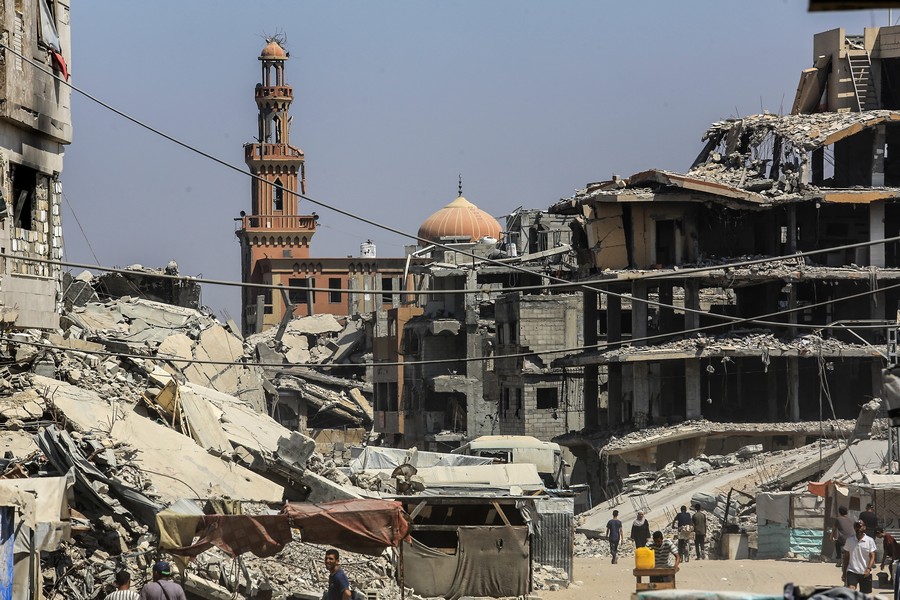
Leaving Gaza in ruins
“The Hamas movement adheres to ‘resistance’ as a strategic option, but at the same time attempts to adapt its actions to the current political and humanitarian circumstances in the Gaza Strip.” This is how the Hamas website Al-Risalah summarized the terrorist organization’s position in light of its current challenges, marking the 38th anniversary of its founding. It relied on the words of Khalil al-Hayya, the leader of Hamas in Gaza.
In an interview granted to the Qatari network Al Jazeera last week, Khaled Mashaal said: “The war in its total form has undoubtedly ended, and we hope and are working to ensure it does not return.”
Regarding Israel’s two central demands, anchored in President Trump’s 20-point plan, Mashaal presented unsurprising compromise formulas. Regarding the transfer of power from Hamas, he noted the movement’s agreement to the establishment of a technocratic government “and for a union between the Gaza Strip and Judea and Samaria”. Regarding the disarmament of Hamas and the demilitarization of the Strip, Mashaal repeated the “hudna” idea, holding fire and keeping weapons without disarming.
With these formulas and a willingness to support the deployment of an international stabilization force, Mashaal hopes to convince the mediating countries, and through them the US, to pressure Israel to move to Stage B of the Trump plan.
This is the stage supposed to provide the Palestinians with one of the most important achievements from their perspective following the halt of the war, a significant Israeli withdrawal from Gaza territories, including the southern, northern, and eastern areas currently under IDF control, except for a narrow security strip along the border area (the security perimeter). This stage is intended to pave the way for a complete IDF withdrawal in the third stage.
At the current point in time, what interests the American administration more than anything is the stabilization of the ceasefire, cementing a reality of non-belligerence that will allow the US president to take credit for this achievement and move on to realizing his other plans.
However, it is difficult to say that under current conditions, moving to the second stage is an Israeli interest. The opposite is true! IDF control of the areas from which it is supposed to evacuate not only improves security preparedness for various scenarios but also leaves Israel with a significant lever of pressure on Hamas and the mediating countries to fulfill its demands.
In Israel’s view, the ceasefire is not the goal. Dismantling the enemy’s capabilities and demilitarizing the territory of weapons are the main goals in Gaza, and so far, not only have they not been achieved, but apart from declarations of commitment to this, no practical plan has been presented to achieve them.
Now, after all the living hostages and almost all the deceased hostages have been returned, withdrawal from these areas is a price Israel is being demanded to pay, an interest of the Palestinians and the guarantors of the agreement, but not of Israel.
Implications for Hezbollah
As has been written more than once, the vacuum created by the absence of clear definitions for the terms “demilitarization” and “disarmament” is beginning to be filled with creative interpretations, like the one presented by Khaled Mashaal. Israel cannot settle for superficial solutions. Its approach regarding the issue of Hamas’ demilitarization will influence not only Gaza, but also its efforts to bring about the dismantling of Hezbollah.
The political echelon would do well to clarify simply that the meaning of the demand to demilitarize the territory is that the Gaza Strip remains clean of any military capability, light or heavy weapons, offensive or defensive, ammunition, production means, tunnels, naval and aerial vessels, communication, command and intelligence means, neither in the hands of Hamas nor in the hands of any other Palestinian element in this territory.
From Israel’s perspective, it is preferable to leave the situation in the Strip as it is rather than “progress” in an outline that will not advance its goals, will increase pressure on it, and will only burden its conduct. A Gaza Strip where half is under Israeli control and the other half is immersed in destruction and ruin with no future, without hope, and without rehabilitation, is preferable to an outline that does not include true demilitarization of military capabilities.
Published in Israel Hayom, December 15, 2025.