
 Asher Fredman
  Gilad Erdan

3.2K


- The U.S. State Department’s Strategic Plan for 2026-2030 declares: “The Department will no longer fund or support international organizations that act contrary to America’s interests or that erode our sovereignty.” This statement reflects an important paradigm shift. International institutions are not ends in themselves. The United States should participate in them only when the benefits to American interests outweigh the costs.
- The traditional American approach treated the United Nations as flawed but necessary, assumed its defects could be addressed through reform, accepted America’s disproportionate financial burden as the price of leadership, and viewed continued participation as necessary to preserve influence. These assumptions no longer stand up to scrutiny.
- In reality, the UN repeatedly undermines American interests, advances the positions of China and other adversarial powers, fails to deliver international peace and security, and has become a caricature of bureaucratic waste and bloat.
- The central problems with the UN are structural. The UN’s core Charter, procedures, membership, political blocs, and incentives create a system which undermines American sovereignty and interests while generating institutional sprawl.
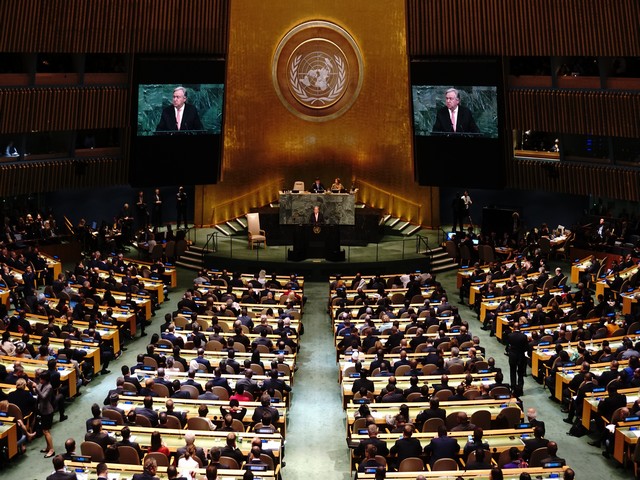
- The flaws begin with the UN’s one-country-one-vote structure. Every member of the General Assembly has one vote, regardless of population, power or contribution. From 2015-2024, U.S. taxpayers provided roughly 28 percent of all government contributions to the UN, equal to the contributions of 183 other member states combined. In 2024 alone, the United States provided $14.3 billion to the UN system. By contrast, the lowest-assessed countries are charged less than $40,000.
- It is a mistake to think that the one-country-one-vote principle shapes only unimportant General Assembly resolutions. It in fact affects a wide range of UN bodies, elections, decisions, budgets, initiatives, and norm-setting processes. States that pay little can expand budgets, preserve politicized bodies, create mandates, block reform, and advance anti-American positions, while American taxpayers fund the machinery.
- China has learned how to exploit this system. Through the G77 and China bloc, Beijing can influence the votes of nearly 70 percent of UN members. The result is a system in which China and other hostile powers use the language of multilateralism to advance strategic goals.
- The UN has therefore become a platform for attacks on U.S. sovereignty and national security, including efforts to delegitimize U.S. sanctions, undermine nuclear deterrence, and advance migration norms over U.S. objections.
- Nowhere are the UN’s politicization and double standards clearer than in its treatment of Israel, a country described by the 2026 U.S. National Defense Strategy as a “model ally” of the United States. Israel alone faces a permanent, multi-layered machinery of condemnation across dozens of UN bodies, councils, special procedures, commissions, secretariat units, databases, and recurring annual resolutions. This directly harms American interests and creates tools that can be turned against America itself, including politicized reports, committees, special rapporteurs, blacklists, lawfare campaigns, and international criminal accusations detached from reality.
- The UN has failed at its most basic purpose: maintaining international peace and security. While UN regular and peacekeeping budgets grew, the number of global conflicts increased. From Rwanda to Srebrenica, Syria, the DRC, Lebanon and beyond, the UN repeatedly failed to prevent massacres, wide-scale displacement, sexual violence, and the build-up of terror armies. With UNRWA, the UN created a massive bureaucracy that promotes radicalization, perpetuates conflict, and was thoroughly infiltrated by terrorists.
- By contrast, U.S.-led diplomacy, leverage, and frameworks have repeatedly produced outcomes and breakthroughs that the UN could not deliver.
- The UN cannot and will not carry out the fundamental reforms necessary to fix the organization. U.S. pressure can produce cost-cutting and administrative efficiencies, but it cannot change the UN’s basic structure or member-state incentives. This is because the very countries that benefit from bureaucratic sprawl, waste, and bloat are the ones with the authority to determine the extent and nature of reform. UN80, the UN’s latest reform initiative, proves this point.
- UN80 exposed absurd institutional sprawl. Since the UN’s founding, more than 40,000 mandates have been adopted by the UN’s main bodies. 86 percent of active mandates lack sunset clauses or termination reviews. The UN Secretariat processes an average of 2,300 pages of documentation every day. In 2024 alone, it supported more than 27,000 meetings and produced more than 1,100 reports. Processing these meetings and reports costs roughly $360 million annually, about 10 percent of the UN regular budget.
- The internal management picture is no better. Only about 40 percent of UN entities have strategic plans, and only 30 percent operate with frameworks that connect resources to results.
- S. pressure has helped secure some administrative and cost-cutting measures, including a 15 percent budget cut, which removed $570 million from the UN regular budget. But achieving deeper and more substantive reforms, such as retiring mandates, closing bodies, and ending the operation of duplicative, politicized, or wasteful mechanisms, would require the consent of the very states that benefit from their existence.
- For American policymakers, the central question is therefore not whether the UN can be made marginally more efficient, cost-effective, or unbiased. The question is whether the UN system can become sufficiently accountable and aligned with American interests to justify continued U.S. engagement on a broad scale. The answer is no.
- The United States should therefore adopt a new strategy with relation to the UN: “Disengage, Withdraw, and Replace.” The U.S. should maximally disengage and withdraw from the UN, and replace it wherever possible with better alternatives.
- This does not mean America should leave the world. It means America should lead more effectively by distinguishing necessary international functions from the failed institutions that currently perform them.
- Congress should establish a presumption of zero automatic funding for the UN system. No assessed or voluntary contributions should be made unless Congress specifically authorizes the payment’s amount, purpose, duration, and safeguards.
- The White House should create an interagency task force to manage lawful and orderly disengagement, while preserving case-by-case cooperation with the UN as necessary.
- The United States should be willing to allow its General Assembly vote to lapse if withholding assessed contributions triggers Article 19 of the UN Charter. America’s influence does not come from possessing one vote in a chamber where it is routinely outvoted by blocs of states with competing interests.
- Responsible withdrawal requires replacement where possible. The United States should build non-UN mechanisms for humanitarian delivery, global health cooperation, technology development and governance, security, counterterrorism, standard setting, legal coordination, and strategic development. It should rely on bilateral agreements, alternative diplomatic frameworks, vetted NGOs, faith-based organizations, private logistics firms, and mission-specific coalitions, while preserving genuinely useful technical cooperation with the UN.
- Congress and the administration should end the presumption that UN credentials, privileges, and immunities shield misconduct. Where appropriate, the United States should deny or revoke visas and impose personal sanctions on UN officials or affiliated personnel who support terrorism, abuse diplomatic privileges, or target U.S. personnel and allies through politicized legal campaigns. Congress should clarify that U.S. courts should not recognize UN privileges or immunities for personnel accused of terror-related offenses, corruption, gross violations of human rights, or other serious criminal conduct. In cases such as UNRWA, Congress and the administration should determine whether specific UN-linked offices, committees, unions, contractors, or personnel meet the criteria for terrorism-related sanctions or designation.
- Withdrawal must be durable. Congress should repeal or sunset outdated statutory authorizations for U.S. participation in UN bodies from which the United States has withdrawn, and require congressional approval before future reentry. Washington should also align foreign aid and trade benefits with countries’ behavior in international organizations.
- Disengagement from the UN does not mean America is leaving the world. It means America is leaving failed structures. The U.S. should not treat outdated commitments as permanent obligations. It should build a new architecture of international cooperation grounded in sovereignty, accountability, burden sharing, measurable results, coalitions of capable allies, and peace through strength.
*The opinions expressed in Misgav publications are the authors’ alone.