
 Dr. Yossi Mansharof
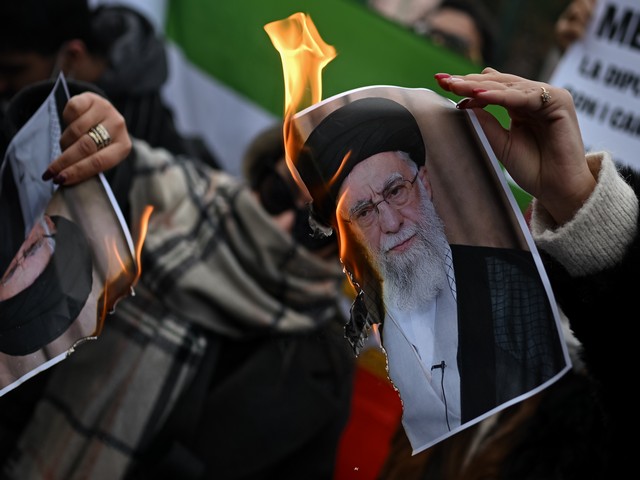


The leadership of the Islamic Republic of Iran is currently confronting one of the most complex and dangerous challenges in its history. This is not merely an economic or diplomatic crisis but an existential one, pitting the regime’s survival against the erosion of national sovereignty.
Against the harsh reality confronting the regime on the domestic front and in the regional and international fronts, internal voices within Iran warn that the public has reached the limit of its endurance. At the same time, senior political figures fear that any retreat would mark the start of a “slippery slope” ending in total capitulation. On the political margins, the regime led by Khamenei is, for now, blocking calls for a preemptive strike against Israel, while stressing that its “finger is on the trigger” and that preparations for war have been completed.
“The public is exhausted”
The reformist camp is visibly split into two groups. One, which includes leaders of the Green Movement protests, Mir-Hossein Mousavi and Mehdi Karroubi, is calling for the drafting of a new constitution and the establishment of a new system of government. The other, which includes former president Mohammad Khatami and others, is urging maximum flexibility and a willingness to cross the red lines set by Supreme Leader Khamenei.
Senior reformist activist Gholam-Hossein Karbaschi gives voice to the bleak mood on Iran’s streets. According to him, the public is “exhausted” by sanctions, by the negotiations themselves, by insecurity and by the soaring cost of living. Karbaschi points to the latest protest waves as an unprecedented breaking point “not only in the history of the revolution but in Iran’s history as a whole,” expressing shock at the killing of about 3,000 people during the protests, while opposition figures claim that 36,500 people were killed.
The solution he proposes to President Masoud Pezeshkian is a “Rafsanjani-style move.” Just as Hashemi Rafsanjani, who managed the war against Iraq in the 1980s, pressed Ayatollah Ruhollah Khomeini to end the war once he realized the country’s resources had been exhausted, and proposed tying the decision to his own assumption of responsibility and resignation, so too should Pezeshkian bear the political cost and lead the way to an agreement with the US. For this camp, the deadlock is a ticking socio-economic time bomb that only a political compromise can defuse.
Fears at the top
By contrast, Foreign Minister Abbas Araghchi outlined a worldview in remarks at a conference at Iran’s Foreign Ministry in Tehran on February 8, portraying concessions as a “deadly poison.” In the regime’s senior leadership view, as expressed by Araghchi, and against the backdrop of the unprecedented US operation involving the abduction of Venezuelan President Nicolas Maduro, the world has returned to the “law of the jungle.” In this reality, the US is pursuing a policy of “peace through strength” while showing contempt for international law. The central fear, therefore, is that any meaningful concession would be interpreted as weakness and lead to further demands “with no end.”
In a world where “the weak are trampled,” Araghchi’s proposed solution is the exact opposite: steadfastness and strengthening. Diplomacy, under this approach, is not meant to reach compromise but to keep “Iran’s flag flying high” while projecting power. This lies at the heart of the deadlock, the understanding that compromise is essential for domestic calm but is perceived as strategic suicide in the face of an external enemy.
Within this tangle, Iran is seeking room to maneuver. Ali Shamkhani, recently appointed secretary of the Supreme Defense Council, proposed a limited compromise in a media interview: reducing uranium enrichment from 60 percent to 20 percent in exchange for “appropriate compensation,” while stressing that negotiations would be confined solely to the nuclear issue. Given President Donald Trump’s statements and the unprecedented buildup of US forces around Iran, there is considerable doubt that Washington would accept such a negotiating framework. Accordingly, Iran continues to prepare for a military scenario.
Iran’s chief of staff of the armed forces, Abdolrahim Mousavi, said his forces were prepared for a prolonged war against the US and emphasized that while Iran does not seek a regional war that would set the region back, including Iran itself, by years, it would not hesitate to respond with force.
Khamenei’s strategic choice
Ultimately, Iran has found itself in an unprecedented situation primarily due to a strategic choice made by Khamenei himself. The decision to depart from a doctrine based mainly on the use of proxies and to respond directly to Israel from Iranian territory, following the killing of Hassan Mahdavi, commander of the Syria and Lebanon Corps, in April 2024, pulled Tehran into a circle of direct confrontation that it had avoided for decades.
This came despite pleas from reformist circles urging Khamenei in advance to show restraint, warning that this was a strategic trap set by Prime Minister Benjamin Netanyahu, designed to drag Iran into an open and direct clash. Thus, in the name of projecting strength and deterrence, the regime has found itself more exposed than ever, without an effective regional buffer, facing growing external pressure and an intensifying internal crisis. This convergence of factors underscores the depth of the dead end in which Iran now finds itself. Accordingly, it appears that during his upcoming visit to Washington, Prime Minister Netanyahu’s mission will be to ensure that Trump does not stray from his promise to demonstrators that “help is on the way.”
Published in Israel Hayom, February 09, 2026.
The opinions expressed in Misgav publications are the speakers’ alone.