

 Meir Ben Shabbat


An old Arabic proverb expresses a practical approach to life: al-af‘al ablagh min al-aqwal –actions are more persuasive than words. Israel has been putting that principle into practice in recent days in the Gaza Strip and Syria, after the diplomatic discourse surrounding both arenas created confusion and ambiguity about its current policy toward them.
Following Israel’s unusual strike in northern Syria, the prime minister explained the rationale in simple terms: “We will not tolerate Turkish military entrenchment moving south (toward Israel), because it threatens us, and we made that clear in general terms. We saw that Turkey intended to establish itself at an airfield south of its border, near Aleppo, and we sent a ‘don’t’ message. The message got through, but apparently they did not hear it, so we made sure they understood.”
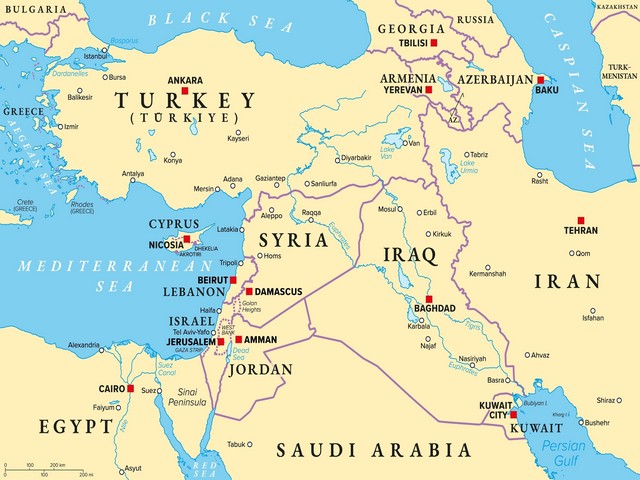
The target of the Israeli strike was the Abu al-Duhur military airfield in Idlib province, about 70 kilometers from the Turkish border. A Turkish delegation had visited the site a week earlier, apparently as part of Ankara’s reconstruction efforts.
Through the strike, Israel sought to signal to Turkey and Syria that it would not allow the deployment there of various weapons systems, from air-defense systems to drones. One need not be a military expert to understand that the struggle between the countries also concerns control of, and freedom of movement through, the airspace.
The Israeli strike came at an early stage before weapons and personnel had been deployed whose subsequent targeting could have significantly increased friction and risk.
Turkey, more than any other country, has demonstrated an ability to exploit global great-power competition and the changing Middle East to establish itself as a dominant regional power. It “dances at every wedding,” extracting political dividends from every player.
Following the collapse of the Assad regime and the forced withdrawal of Iran’s military presence, Turkey became the dominant player in Syria. Turkish involvement has evolved from localized territorial control in northern Syria into broad influence across the country. Today, Turkey is a principal patron of the new government in Damascus, assisting with infrastructure reconstruction and the development of the Syrian air force and military.
Turkey is expanding and deepening its grip on its southern neighbor in numerous ways: developing energy infrastructure, opening trade corridors, building transportation infrastructure, mining phosphates, and establishing chemical industries. Its involvement extends even to influencing municipal administration in certain areas and providing healthcare, education, higher education, banking, and financial services.
Syria may be central to Erdoğan’s strategic vision, but it is only one component of his broader conception of “neo-Ottomanism.” His openly stated ambition is to restore Turkey to the status of a regional superpower and extend its influence far beyond its formal borders. This vision was evident recently in Turkey’s signing of the “Mecca Joint Defense Agreement” (MJDA) with Saudi Arabia and Pakistan, but even earlier in its efforts to open intercontinental trade corridors, its deep involvement in Africa, and its adoption of the “Blue Homeland”—Mavi Vatan—doctrine, which articulates its ambitions in the eastern Mediterranean.
Add to these trends Erdoğan’s overt hostility toward Israel, and it becomes difficult to ignore the potential for strategic friction and confrontation with him—even without mentioning the Palestinian issue and his support for Hamas.
A year ago, Turkey allowed the “World Union of Muslim Scholars” conference to take place in Ankara. During the gathering, a consensus was formulated granting religious legitimacy to the October 7 attack and declaring that “the existence of the Zionist entity lacks religious legitimacy.” Turkey continues to host senior Hamas leaders, some of whom are involved in directing terrorism in Judea and Samaria directly from Turkish territory. In addition, it is waging a legal and public-relations campaign accusing Israel of war crimes.
Indeed, Turkey is not Iran. It is a NATO member, Erdoğan has a close relationship with Trump, and despite the profound crisis, diplomatic relations with Israel have not been severed. Precisely in order to prevent rivalry from turning into military confrontation, it is important to make the red lines clear—and that is exactly what Israel sought to accomplish with the airstrike in northern Syria.
Nukhba Terrorists at a Café
The clearest illustration of how Hamas viewed Kushner’s visit came through reports of one of the counterterrorism operations carried out shortly after his meeting with Netanyahu. Buoyed by the diplomatic discourse surrounding the “15-point framework,” Hamas terrorists felt secure enough to venture into the streets and sit in a café without fear.
In another case, involving terrorists targeted in central Gaza City, the IDF spokesman stated that they had been “planning to carry out terrorist attacks against IDF forces operating in the Gaza Strip.”
A day earlier, reports emerged of Hamas detonating an explosive device and terrorists opening fire in the area of the Yellow Line in northern Gaza.
The connection between these developments requires no great leap of imagination. A great deal of talk, considerable ambiguity, strange mechanisms, and the introduction of the idea of a Palestinian state through the gates of Gaza—that is a framework that gives Hamas precisely what it needs most: security, freedom, and hope. And if that were not enough, the framework offers Hamas an additional prize: a declaration of intent regarding a path that would ultimately lead to the establishment of an independent Palestinian state.
Once people begin speaking about “violations by Hamas,” a perception takes shape of a conflict in which both sides have grievances about the other’s violations and the mediators’ role is to bring the parties toward a compromise. Kushner’s meeting with Hamas commander Khalil al-Hayya reinforces that impression.
But from Israel’s perspective, there is no symmetry whatsoever. There is no shared objective or common interest. Israel has one objective in Gaza: to destroy Hamas.
Complacency must be avoided. It is reasonable to assume that the enemy is using every spare minute to rebuild its capabilities and devise new schemes. The possibility of a kidnapping attack must remain at the forefront of our soldiers’ minds, at every level and at all times.
Counterterrorism operations must continue—not only against immediate threats or those who participated in the massacre. The senior Hamas leadership that remains alive must feel the sword of counterterrorism hanging over it. The same applies to Hamas government officials, infrastructure operatives, logistical facilitators, and anyone connected to Hamas.
“Everyone understands that developments in the Gaza Strip are unfolding at an especially sensitive time for Netanyahu, who is guided by electoral calculations above all else,” Hamas’s Al-Resalah website wrote in an editorial following Israel’s resumption of counterterrorism operations in Gaza.
One can guess where they get their arguments. There is no need to debate the point with them—or with others who hold the same assessment. Our actions will speak louder than our words—in Gaza, and not only there.
*The opinions expressed in Misgav publications are the authors’ alone.