

 Dr. Yossi Mansharof
  Noa Lazimi

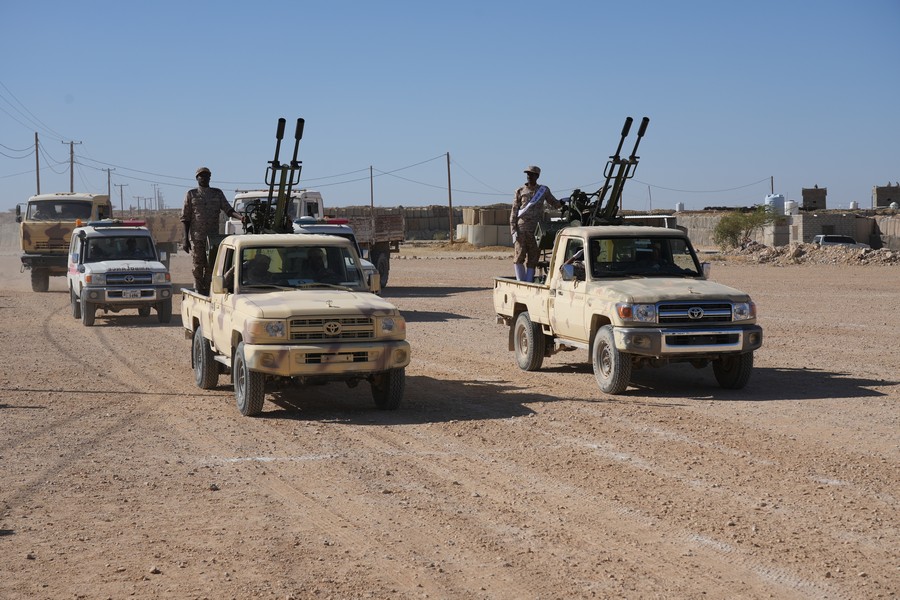


On September 26, the chairman of Yemen’s Presidential Leadership Council, Rashad al-Alimi, set for the first time an official goal of retaking the capital, Sanaa, from the Houthi militias.
Despite this bold declaration aimed at liberating Sanaa, ending the penetration of the Islamic Revolutionary Guard Corps and the rule of its Houthi strategic partner, the Houthis are unlikely to back down easily.
The last year saw a shift from limited escalation to a broad resumption of the Yemeni civil war, after nearly four years of a largely sustained lull. Within a few months, the conflict expanded from tribal unrest and local fighting in al-Jawf and Hodeidah to a direct confrontation with Saudi Arabia, attacks on energy facilities, a maritime blockade, and a ground campaign to control areas that provide access to Bab el-Mandeb.
These events suggest that the Houthis are recovering and retain considerable operational capability. Despite severe financial difficulties – including damage to oil infrastructure,US sanctions, and an internal crisis – the Houthis managed to mount a major ground offensive. They captured Al-Mocha and key positions along Yemen’s western coast, using drones and ground forces on a significant scale and maneuvering through mountainous terrain.
Declaring “a blockade for a blockade,” the Houthis consolidated their hold on strategic positions around the Bab el-Mandeb Strait, including Perim Island.
They also stressed that the naval blockade is directed solely at Saudi Arabia, which may reflect a desire to avoid a wider escalation and the creation of additional enemies.
This interpretation is also supported by the Houthis’ very late entry into Operation Roaring Lion, when they launched only a handful of missiles at Israel – a response that may be explained by concern over Israeli or American military retaliation.
Recent developments, however, may signal a shift. In recent days, Saudi-backed Yemeni government forces dealt the Houthis a heavy blow, recapturing territory seized by the rebels, including key positions along the Bab el-Mandeb Strait. Fighting continues, with reports that Turkey is preparing to send assistance and Pakistani fighter jets have already carried out strikes in Yemen.
The Iran factor
The timing of the escalation also raises the question of Iran’s role. No conclusive evidence suggests Iran ordered the escalation, but it is reasonable to assume that the move was, at the very least, coordinated with it.
Tehran may have held the Bab el-Mandeb “emergency card” for this moment, given the extreme difficulty it faces in exporting oil and the mounting economic pressure on the country.
This predicament appears to have prompted it to approach the US with a ceasefire proposal, which President Donald Trump rejected.
Meanwhile, the Americans continue to move oil out of the Persian Gulf, and countries in the region are adapting through alternative routes.
In this sense, Bab el-Mandeb could serve Tehran not only as a means of pressuring Saudi Arabia but also as indirect leverage in the struggle over the Strait of Hormuz. But Tehran is increasingly losing its Hormuz bargaining chip, and if efforts to contain the Houthis continue, it may lose its Bab el-Mandeb card as well.
Simultaneously, the escalation is shaped by internal unrest and the struggle for control of Yemen, with Saudi Arabia strongly backing the internationally recognized Yemeni government.
It remains unclear whether the Houthis will keep their confrontation with Saudi Arabia separate from other fronts or link them. If they do, additional countries, including Israel, could become targets.
There are considerations on both sides, and it shouldn’t be assumed that the Houthi rebels currently want to demonstrate a broad, unconditional commitment to their Iranian strategic partner. They have worked to rebuild their capabilities since the most recent Israeli and US strikes, but they face domestic opposition, tensions, and tribal rivalries.
It is therefore unclear whether they would judge it wise to risk another campaign that would bring extensive American or Israeli strikes on their territory.
Still, the confrontation is not confined to Yemen or Saudi Arabia: the threat to shipping through the strait creates uncertainty in global commodity and energy markets, driving oil price fluctuations, disrupting international trade, and increasing shipping costs. Thus, while the Houthis’ advances exert pressure primarily on Riyadh, they generate consequences that extend globally.
A second choke point
Developments in Yemen show that, for Iran, Bab el-Mandeb is no longer a secondary arena on the Middle East map. It is a strategic asset that can be brought into play alongside pressure in the Persian Gulf.
If the Houthi establish foothold in the area, Tehran will gain another source of leverage over Saudi Arabia, the US, and global trade and energy flows, without deploying its own forces there.
For Israel, this shift cannot be treated as a local development at the southern end of the Red Sea. Experience in Lebanon has shown the cost of allowing an Iranian proxy to establish itself gradually in an area of strategic importance.
Bab el-Mandeb is a strategic junction with direct implications for Israel, its trade routes, and the regional confrontation with Iran.
These developments should therefore be understood as part of the broader struggle over Iran’s ability to project power far beyond its borders and build new sources of leverage.
Preparing for conflict
The escalation in Yemen and the Red Sea renews the urgency of building a regional coalition to counter the Houthi threat. As a general principle, Israel has a clear interest in supporting those seeking to curb the Houthis through a regional coalition with Saudi Arabia, the United Arab Emirates, Somaliland, and other Red Sea partners.
The success of such a coalition, however, would depend largely on reconciliation between Saudi Arabia and the UAE, the two most influential players in the arena until Abu Dhabi was recently pushed out.
If political conditions permit, Israel could also offer training to Houthi opponents in Yemen, including government forces and tribal groups, in close coordination with the internationally recognized Yemeni government and Saudi Arabia.
Presently, with tensions running high simultaneously on several fronts, it is unclear whether direct military intervention would be the right choice for Israel.
Nevertheless, Israel can still deepen intelligence assistance to Saudi Arabia, strengthen regional coordination, and prepare for the possibility of another round of fighting with the Houthis. It should use the current lull to develop capabilities for precise ground operations.
Such capabilities could strengthen Israel’s deterrence against the Houthis and broaden its range of responses beyond strikes on infrastructure from the air and sea. Targeted raids could focus on leadership centers, military expertise, command-and-control systems, and weapons infrastructure, demonstrating that Yemen’s geographic distance does not put them beyond Israel’s reach.
Israel must also consider that the Houthis are gradually developing the ability to conduct raids against Israel and should work to disrupt such preparations.
The lesson Israel drew from Hamas’s October 7 massacre was the need to act against emerging threats before they materialize.
Published in The Jerusalem Post, October 13, 2026.
*The opinions expressed in Misgav publications are the authors’ alone.